
Perimenopause Isn't a Crisis. It's an Awakening
What Jamie Riva's Perils to Pearls gets right about midlife — and why we couldn't stop thinking about it. Every so often, a piece of writing puts words to something you've felt in your body but never managed to say out loud. For us, that piece is photographer Jamie Schofield Riva's essay, Perimenopause: Perils to Pearls. It's one of the most honest portrayals of the perimenopause experience we've read in a long time — and if you're somewhere in the thick of this transition, we think it might do for you what it did for us: make you feel a little less alone.
“I don’t feel like myself"
Riva opens with the phrase that menopause specialists say they hear most often as hormones begin to shift: “I don’t feel like myself.” If that sentence lives somewhere in your chest, you are in enormous company. Perimenopause — the years-long hormonal transition leading up to menopause — can make you feel like your body is betraying you, or like you simply don’t recognize yourself anymore.
What makes the feeling worse is how often it goes unnamed. Riva describes living with symptoms for years before she understood what was happening. That lag is incredibly common: women routinely juggle several overlapping symptoms before anyone connects the dots to peri.
The symptoms no one warns you about.
Because estrogen receptors exist throughout the entire body, declining and fluctuating hormones can ripple far beyond hot flashes. In her essay, Riva names the ones that hit her hardest — and they map almost exactly onto what so many women quietly endure:
• Insomnia and night sweats so intense she was changing soaked sheets daily
• Brain fog and intense mood swings
• Bone and joint pain tied to the loss of estrogen — pain that months of physical therapy and clear MRIs couldn’t explain
• Night-waking panic attacks that arrived uninvited and unwelcome.
One of the most quietly devastating details: her joint and back pain eased almost immediately once she began receiving a steady dose of estrogen — after specialists had admitted they simply didn’t know enough about perimenopause to help. Sound familiar?
The knowledge gap is real — and it isn’t your fault.
Riva recounts a menopause summit where leading doctors delivered an urgent message: you may know more about peri than your doctor does — and that’s not a personal failing on either side. Many physicians, by their own admission, were never properly taught about perimenopause in medical school. The funding behind the gap is just as stark. Riva cites a figure from the summit — that only about 1% of healthcare funding goes to women over 40. Zoom out and the pattern holds: less than 9% of NIH research funding went to women’s health over the last decade, and menopause only received its own dedicated NIH research category in 2023.
The under-investment is structural, not imagined. Which leads to the most important takeaway of Riva’s piece, echoing Dr. Mary Claire Haver: advocate for yourself. Bring your knowledge to your doctor if they aren’t bringing it to you. And if they won’t work with you, find someone who will. “Look at your friends, and don’t let your friends suffer either.”
From peril to pearl: the reframe that changes everything
Here’s why we truly couldn’t put this essay down. Riva refuses to call this season a crisis. She calls it an awakening: “I’m determined to keep my midlife experience an AWAKENING and not a CRISIS.” She doesn’t pretend the hard parts away — she writes openly about grief, about her ovaries “taking a nap,” about the strange ache of a menstrual cycle quietly disappearing after thirty years. But she holds that grief alongside something else: the discovery that midlife is exactly when many women come into their own.
As she puts it, there is nothing sexier than a woman who knows who she is and what she wants — and that comes with age. That tension — shedding and waking up at the same time — is the truest thing anyone can say about this stage. “Grief over times of endings can coexist with the excitement of rebirthing and new beginnings.” That’s not toxic positivity. That’s the whole, complicated, honest picture.
What we take from it at NNABI
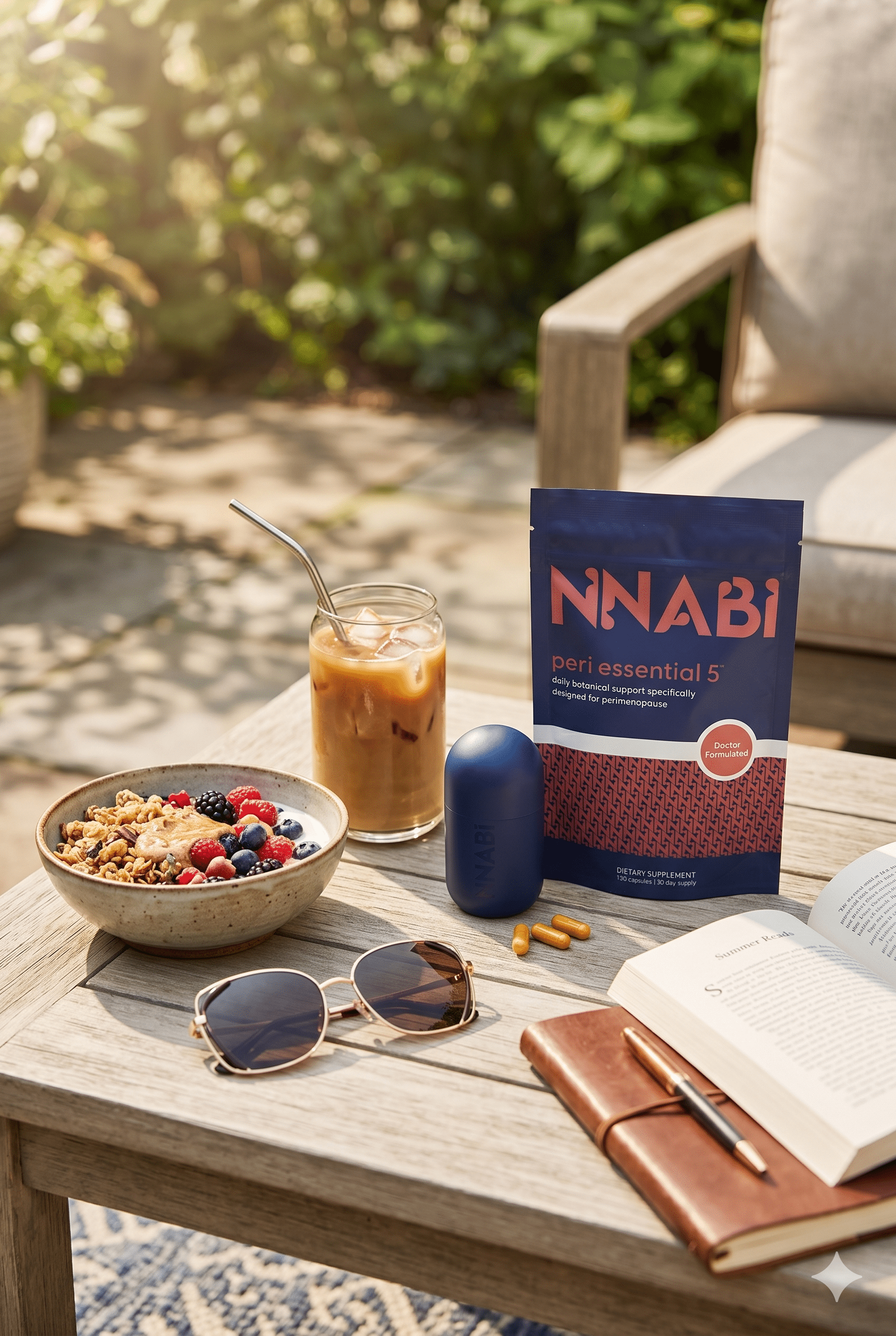
We built NNABI on a single belief: perimenopause is a pivot, not a crisis. So reading a woman arrive at that same truth — through her own perilous, beautiful journey — felt like hearing our mission in someone else’s voice. If Riva’s story stirred something in you, take the next step she models so well: get curious about your own body, ask better questions, and refuse to suffer in silence. Knowledge first. Action next. Relief follows. And whatever support you choose — from holistic practices to talking with your doctor about your options — know that you don’t have to navigate it alone.
That’s what the Peri Babes community is for. 🦋 Most of all, do the thing the essay is really about: send it to a friend.
→ Read Jamie Riva’s full essay, Perils to Pearls Essay and photography by Jamie Schofield Riva (@j.s.riva), quoted with credit and linked in full. We’re sharing and celebrating her work, not reproducing it.
*These statements have not been evaluated by the Food and Drug Administration. This product is not intended to diagnose, treat, cure, or prevent any disease. This article is for educational


Leave a comment
This site is protected by hCaptcha and the hCaptcha Privacy Policy and Terms of Service apply.